⚡
VoltAmpixFAILURE PHOTO TRIAGE
AGENT 55 · 8.2s📷 uploaded 09:42 · analyzed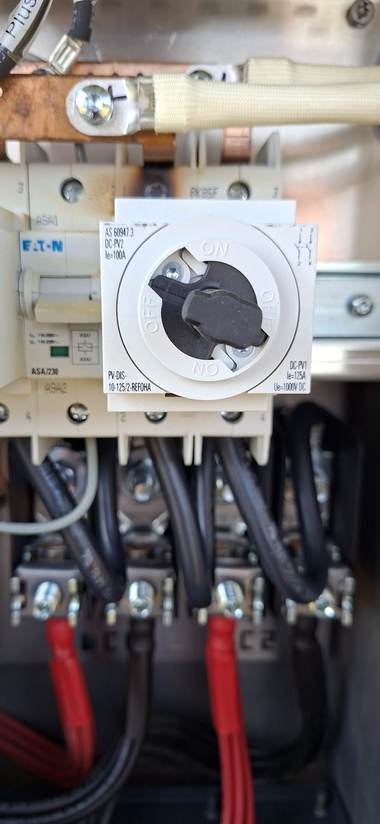
⚠ RISK: CRITICALDo NOT re-energize this circuit. The soot and scorch marks mean arcing has already occurred, and this is a DC solar circuit — DC arcs do not self-extinguish and are a serious fire risk. Important: the solar panels keep producing voltage whenever there is daylight, so the cables feeding this switch may still be live even with everything switched off. Only a qualified person familiar with PV systems should work here, after isolating at both the inverter and the string level.
Do this now
- Leave the disconnect switch in the OFF position and do not operate it again
- Shut down the solar inverter using its normal shutdown procedure if you can do so safely
- Do not touch the terminals, cables, or busbar above the switch — treat them as live
- Keep the panel door closed, restrict access, and note any burning smell or unusual sounds
- Photograph the panel schedule or circuit labels so the electrician knows exactly which string this is
- Call a PV-qualified electrical contractor today
🔍 What is this? ID CONFIDENCE: HIGH
a DC disconnect switch for a solar (PV) installation — the rotary switch used to safely cut the power coming from the solar panels
Model
PV-DIS-10-125/2-REFOHA
READ: EATON · AS 60947.3 · DC-PV2 Ie=100A · DC-PV1 Ie=125A · Ue=1000V DC · PV-DIS-10-125/2-REFOHA · ON · OFF
🔥 Why did it fail?
One of the top connections has been running hot and has started to arc — the burn marks on the panel show heat escaping from a single joint, not from the switch as a whole.
- dark soot and scorch marks on the mounting plate directly above the switch, concentrated around the top terminal area of poles 1/3
- brown thermal discolouration on the panel behind the copper busbar connection above the switch
- heat staining localized at one termination point rather than spread across the device
- switch housing and rotary handle appear mechanically intact
HIGHLoose or insufficiently torqued termination at the top busbar/cable lug
The soot is concentrated at one connection point, which is the classic signature of a loose joint heating up over time. PV DC circuits cycle thermally every day (cold mornings, hot afternoons), which gradually works terminations loose if they are not checked.
MEDIUMCorroded or degraded contact surface at the lug-to-busbar joint
Oxidation between copper surfaces raises resistance and generates heat under load even if the bolt is tight. The joint must be opened, cleaned, and remade — not just re-tightened.
LOWSwitch contact degradation from repeated DC switching under load
DC arcs do not extinguish by themselves the way AC arcs do, so switching a loaded PV string wears contacts faster. Less likely here because the visible damage is at the termination, not inside the switch — but heat from the joint may have damaged the switch internals.
Important: a new switch alone will NOT fix this — the loose termination will destroy the replacement too. The connection must be remade first.
🔧 Before replacing — tell your electrician
- Open, inspect, clean and remake the top busbar/lug termination — inspect the busbar and cable lug for heat damage and replace the lug if annealed or discoloured
- Torque-check every termination on this switch and the adjacent devices to manufacturer specification
- Inspect cable insulation entering the top terminals for heat embrittlement and cut back to healthy copper
- Verify actual string current against the 100A/125A configuration rating
- Check the ASA auxiliary module wiring for heat exposure
Replacement must match
Replace the disconnect switch even though it looks intact — sustained heat at a termination degrades the contact assemblies and insulation behind it. The replacement must match: 1000V DC rating, PV utilization category (DC-PV1/DC-PV2 per IEC/EN 60947-3), 100/125A configuration, 2-pole series-connected DC wiring arrangement, and the same mounting/frame dimensions.
⚠ PV DC-rated switch-disconnector — a standard AC isolator of similar amperage is NOT an acceptable substitute; the replacement must carry DC-PV1/DC-PV2 utilization ratings at ≥1000V DC
⚠ Verify the auxiliary/trip module (ASA/230) compatibility with the replacement switch — it may need to be transferred or replaced as a set
📋 Contractor brief — ready to send
Site has an Eaton PV-DIS-10-125/2-REFOHA DC disconnect switch (Ue 1000V DC, Ie 100A in DC-PV2 / 125A in DC-PV1 configuration) with an Eaton ASA/230 auxiliary module, showing soot deposits and thermal scorching on the mounting plate above the top terminals, concentrated at the pole 1/3 termination to the copper busbar. Suspected loose or degraded termination with arcing already evident; the circuit has been isolated and the inverter shutdown requested. Please treat as live PV DC until verified. Requested scope: isolate and verify at string and inverter level; open, inspect and remake the top busbar/lug termination, replacing the lug if heat-affected; torque-check all terminations in this section; inspect cable insulation for heat embrittlement; replace the disconnect switch with a PV-rated equivalent (1000V DC, DC-PV1/DC-PV2 utilization, 2-pole series configuration, matching frame) and confirm ASA module compatibility; verify actual string current against the configured rating before ordering.
Copy briefrouted exclusively to ATTA-1 · component + specs attached automatically
This is AI-generated guidance based on a photograph. It is not an inspection and not a certification. All electrical work and any decision to re-energize must be performed and verified by a qualified person in accordance with NEN 3140.